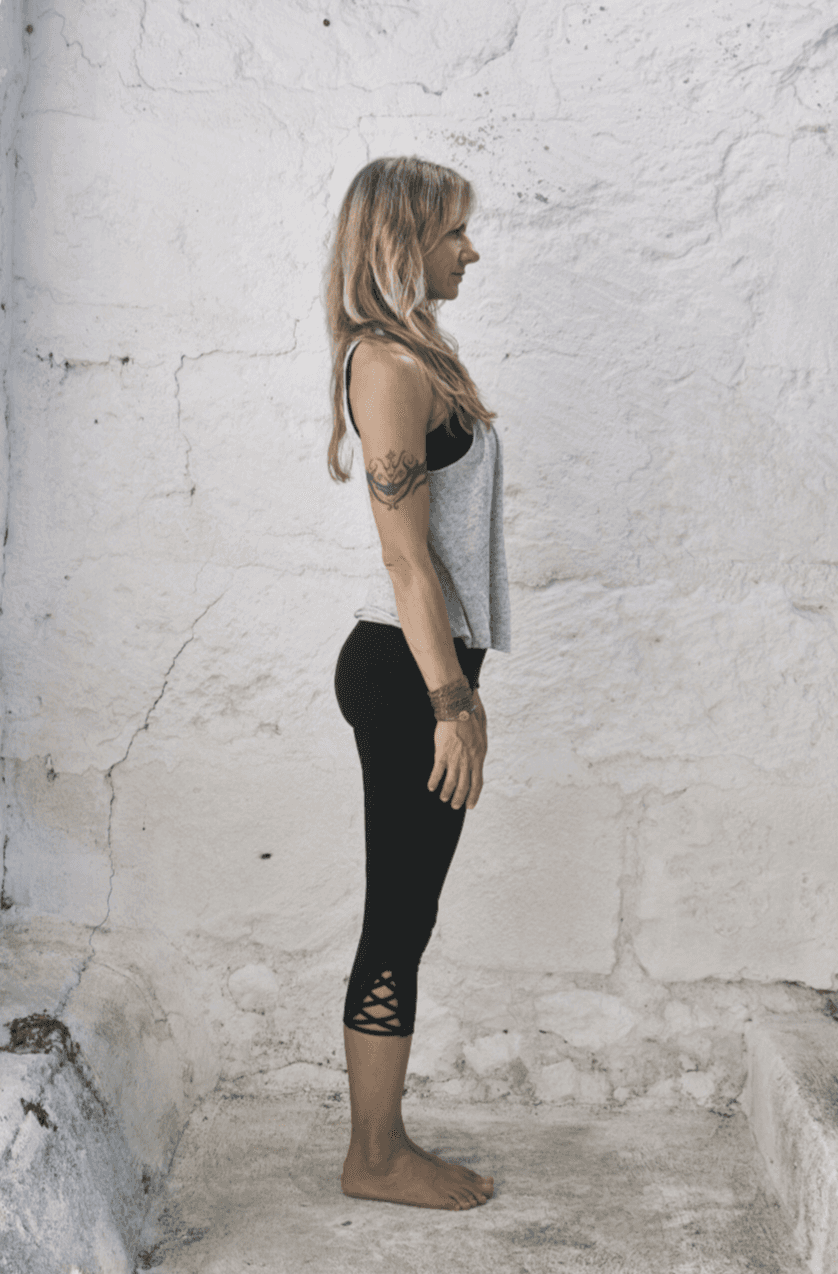
An ode to Tadasana- the foundation of every pose and powerful yoga class
Why it is important to teach Tadasana (over and over again)
For simplicity, I will call the pose Tadasana throughout this post. Though it is called also Samasthiti.
Next time you plan a class, how about going back to basics and focusing on Tadasana?
There’s just so much to learn about Tadasana and it offers you amazing insights into your students.
Read why I think Tadasana is the most important pose in any class, besides Savasana – of course.
The value of going back to basics – oneness in yoga
For me, the moment of stepping into Tadasana at the beginning of the practice, always recalls the very first Patanjali Sutra, 1.1.
“Atha yoga anushasanam” – “Now, the teachings of yoga”.
Along with my students, I too place my feet parallel on the mat, set the intention for our practice and my teaching and yoga begin.
In my first 200 yoga teacher training taught by the amazing Jeanne Heileman, we worked in Tadasana for, I think, three entire days.
Imagine that: three days in Tadasana! How can you work on standing straight for three whole days?
But it made absolute sense to me. It opened my eyes and made me see people in a different way, especially the way they position themselves in life. How we stand says an enormous amount about us.
Why Tadasana?
Tadasana offers the perfect foundation for the inner work we would like our students to experience. And what they would like to experience: oneness in yoga – being one with their body, breath and mind.
Whether you’re an experienced teacher or newbie, going back to Tadasana again and again will really add value to your classes.
Students are often neither present nor aligned when you begin a class. Sometimes you might not be fully there when you step onto your mat. I know I’m often not.
If you can connect your students with their body and breath and enable them to create full awareness at the beginning of the class, you’ll have them for the rest of the time.
Tadasana brings students into their body and aligns them. They’re aware of where they are in that present moment and grounded.
Often, in more Vinyasa style classes we set the foundation in a seated position. But as soon as students start to move, this connection can get lost. Tadasana links passive and active positions.
Whether your students are beginners or advanced, Tadasana will help them return to what is most important about yoga. This will help you make sure your students leave your class happy, feeling that they really did yoga and not just some kind of physical exercise.
To teach Tadasana well and enable our students to dive deeper into other asanas physically and mentally, we need to understand what the pose is truly all about.
Why is Tadasana the foundation for all asanas?
First of all, it indicates “good posture”.
Every bone and muscle is in a neutral position. This shows you what to work on with a student. You can see where the body is out of alignment: is a student’s back hunched, are their knees collapsing, for instance?
Studying how a student is in Tadasana is also a great indication of what props you might need for your teachings, what adjustments would be helpful and of course what adjustments not to make!
For example, with a hunched back you know that every time a student lifts their arms, they’ll have difficulties in keeping their torso neutral. You know that a strap will be a great way to open the shoulders and a block will help the student work on external rotation when lifting the arms up and overhead.
If every bone is aligned into its neutral position in Tadasana, the rest of the body can relax into it as I often say in my classes. The muscles around the bone structures can soften a bit more.
Students can find the balance between activity and working on detailed alignment, “sthira”, while creating calmness, “sukha”, and working on breath awareness. If you establish a soothing breath here, the mind is automatically relaxed.
While in Tadasana, students experience what it feels like to strengthen and open in a balanced way. They use every toe but spread them wide. They stay soft in an active position. They’re grounded but feel light, in touch with the earth and reaching for the sky. They work on detail, but breath and prana are moving.
Remember, your students shouldn’t end up standing like they’re soldiers on parade – we want to enhance prana flow with the practice.
Tadasana reminds students what yoga is really all about again and again. It gives them the lived experience of body awareness as a form of meditation.
If they found it here, then you can advance to philosophical discussions in Pincha Mayurasana.
Let’s not forget that life is anyway mainly based on poses looking more like Tadasana than Bhujapidasana.
Where to place Tadasana in a class
I teach a Vinyasa–Ashtanga inspired type of yoga, so Tadasana often comes at the beginning of the class, linked with Surya Namaskar A and B.
It’s our point zero, as a beautiful singer named Sheela Gathright that I work with says.
To create and present an amazing piece of music, it’s important for the musician to come back to point zero again and again – to pause, find silence, notice where you are. If you’ve lost yourself then this is the place where you reconnect.
On the mat, I believe it’s crucial to ask our students to pause again and again in between the movement, between the Vinyasas, and find the point zero.
No song works if you make sound non-stop. You have to pause, to breath, and to find back to your intention. As a singer on stage, in a conference holding a speech, as a student on the mat, as a parent when arguing with your child. Pausing and reconnecting with our intention – that is what we can learn from Tadasana.
An example what Tadasana can tell you about a student
Recently, a new student in one of my private classes almost hurt himself trying to find his way into Tadasana. Very much a perfectionist, he wanted to do Tadasana so well that he gave himself cramps and was in pain. In Tadasana, from working in an upright position and standing still!
It probably won’t surprise you to know that this student started yoga because he’s very stressed.
Seeing how he was in Tadasana gave me a clear idea on what we needed to work on. If he’s already hurting himself in Tadasana, imagine what might happen in complex poses?
I stick to safe, very easy poses with this student and concentrate more on relaxing his mind with breathwork and mindfulness.
And, although Tadasana is important, don’t teach the pose for too long in your class (three days not needed). When they’re in Tadasana, give them some action points for each part of the body and ask them to move in the pose.
If you’re teaching online, make sure you can see your students completely in Tadasana. Let them know before they take the first class with you that they should arrange their mat and camera so you see their full-body posture.
May our intention as teachers be to work from our heart, be present, continue to search and dive deeper in yoga.
What do you think about Tadasana? Do you have another pose that works for you in your classes?
I've created a list of 108 cues for Tadasana.
If you like this blog post, please share it with your friends and colleagues.
You can also follow me on Instagram.
Thank you for your time!
I bow down to you.
Namaste
Agnes x