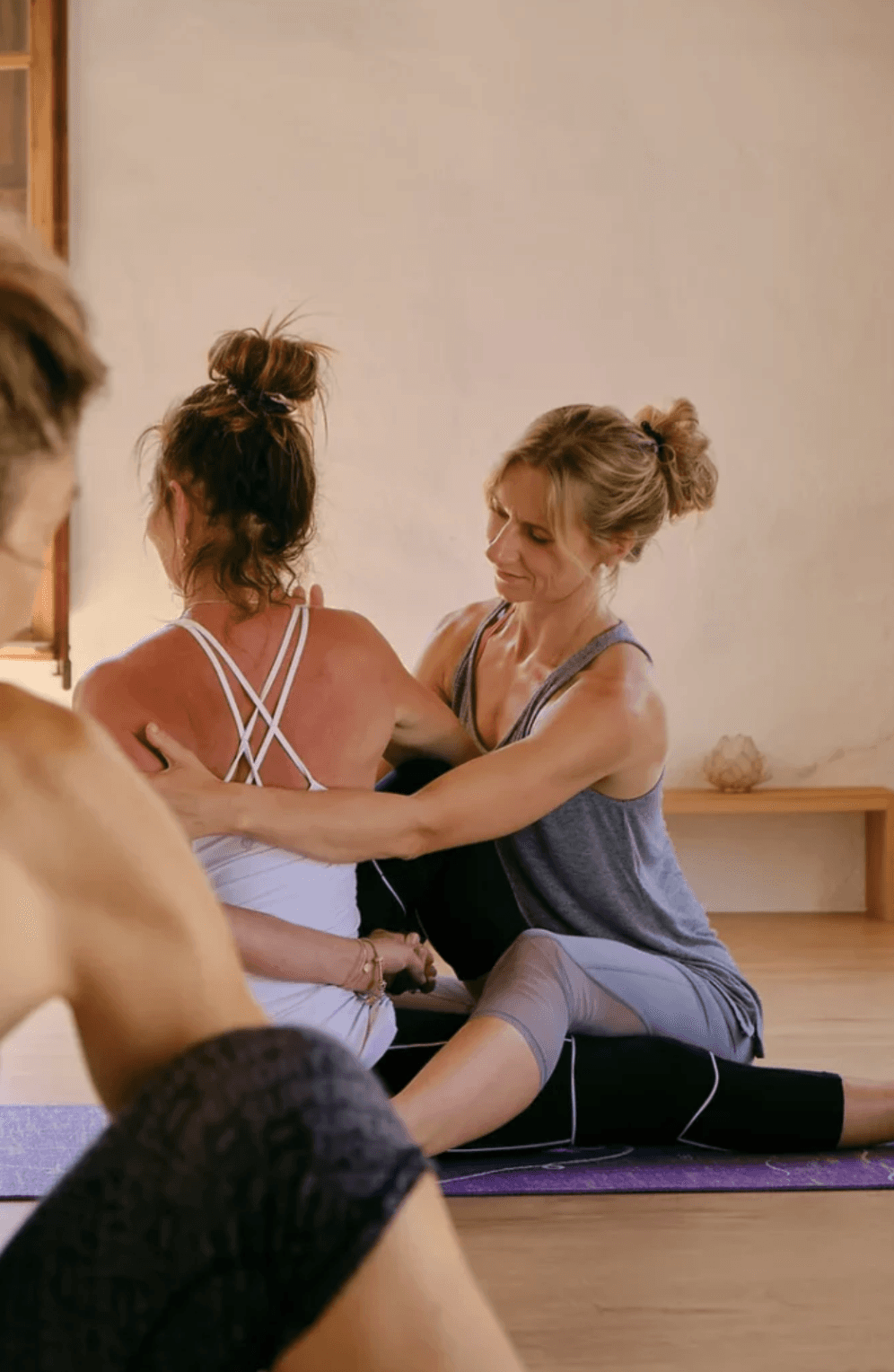
The Art of Touch- The art of adjustments in yoga classes
I know the right kind of adjustment can be incredibly beneficial to students.
Picture a not so flexible student in a seated forward fold, slightly frustrated that he or she will never be able to touch their toes. Happy to be helped, they see the teacher approaching and all the teacher does is touch them for a second in a too gentle way. They are now even more unsatisfied.
But then again. Imagine a yoga student deeply and content in a seated twisted position and suddenly the teacher comes along and adjusts their spine in such a strong and sudden manner so the student is worried throughout the rest of the class if their back is OK.
Scenarios like these are the reason there are several different opinions about adjustments in yoga classes. Some people don’t believe in giving them at all. Even among those who are in favour of adjustments, there are uncertainties.
Is there a right or wrong to adjusting?
Teachers just starting out are sometimes not sure about adjustments and frightened of doing something wrong.
Besides the risk of hurting someone, we’re not sure how to touch the person in the “right way.” But what is right? And is there a right way at all? The answer to the last question is a definite NO. What is right for one person can make another person feel uncomfortable. Some don’t want to be touched at all.
The question for teachers is how can we make sure that what we do when we adjust brings our students deeper into their practice?
The benefits of adjusting
I’m all in favor of careful adjustment and here’s why.
Correcting the posture, without making a student feel they’re being criticised, is about safety. In yoga classes, poses are repetitive. Doing unaligned movements repetitively brings a high risk of injury.
Adjustments bring a student deeper into the practice. Gentle but firm adjustments by a teacher, linked to the breath, help people find more length, space and stability.
When we adjust, we help students focus on their practice, to find back onto the mat. Especially if they’ve become distracted, a touch can ground again. Standing close to a student also helps us check their breathing and offer any necessary advice.
The power of touch
When we touch, we lower stress hormones and increase oxytocin, the “cuddle hormone” that helps create a sense of attachment and trust.
Recent studies have found that seemingly insignificant contact means bigger tips for waitresses. People buy more if they’re touched by a stranger. Strangers are more likely to help someone if a touch accompanies the request. This is true even when people don’t remember being touched. They simply feel there’s a connection and are more comfortable around the person doing the touching.
In sports, teammates that touch each other often are more successful.
But, although touch can be enormously powerful and most of us consider it to be an essential part of life, we’re all different in how we feel about it. A person may even have a history of abuse that they don’t share and either not like being touched at all or be highly sensitive to touch. A good yoga teacher has to be able to know, see and feel what is appropriate before approaching a student.
Psychological research has shown that we are able to send and receive emotional signals without speaking. In one experiment, subjects communicated eight distinct emotions—anger, fear, disgust, love, gratitude, sympathy, happiness, and sadness—that could be measured to 78% accuracy.
Interestingly, the Spanish communicate better by touch than American or English people
[https://www.psychologytoday.com/intl/articles/201303/the-power-touch].
As teachers, then, we should be able to receive clear, unspoken messages from our students before we touch them or if they react negatively when we do so. It means as well that our touch should always be clear and positive, as our students receive the information we send out as well.
Making sure our touch is helpful
Apparently, there’s a formula for giving the perfect handshake
[https://math.wonderhowto.com/news/scientific-formula-for-perfect-handshake-0118137/].
It’s three shakes. My formula for the perfect adjustment is always touch someone for at least the length of one long, calm breath.
Same with adjustments as with handshakes. How do you imagine a comfortable, soothing touch in a pose? You don’t want to feel any dominance or being hurt, you don’t want to feel uncertain. You want to feel someone is with you, like this very personal handshake while looking into your eyes.
When we shake hands, we’re able to look someone in the eye and can tell how they’re reacting to our handshake. But we often can’t look into the eyes of our students when we’re adjusting them. We must be sensitive to their breath and body reaction to our touch to make sure they’re comfortable with what we’re doing.
For me, it comes down to the fact that I want to help my students go deeper into their practice and come out of class feeling better than when they went in, with or without touch.
Touch is truly fundamental to human communication, bonding, and health—so why not using it as a yoga teacher?
In my classes, I see how happy most people are to be touched. It makes the guidance I’m giving them more personal and, in my experience, effective.
If I’m not sure whether a person wants to be touched, I ask their permission.
Ask about my adjustment workshops:
Please get in touch if you’d like to know when my next adjustment workshop is happening.
If you have anything to add to the formula of the perfect adjustment, I’d love to hear from you!
Thank you for your time!
¡Namaste!