Enjoy your dentist appointment with this 61 point meditation
Sep 28, 2019

This year I had my first tooth implant (also yogis are getting old!). Ever since I had an extremely painful, unpleasant experience at the dentist around 20 years ago, I’m someone who breaks into a sweat the moment I sit down in the dentist’s chair.
OK, you don’t feel anything because of the local anesthetic. But you can hear everything: the sound of high-pitched drilling, the dentist talking to the assistant. And the worse thing is all the nervous chatter inside your mind. My internal voice is usually saying “What if the drug stops working now? Or now? Or NOW?”
This time, using the simple Yoga Nidra 61-point meditation, I relaxed so much during the surgeries that I almost enjoyed it.
What is the 61-point meditation?
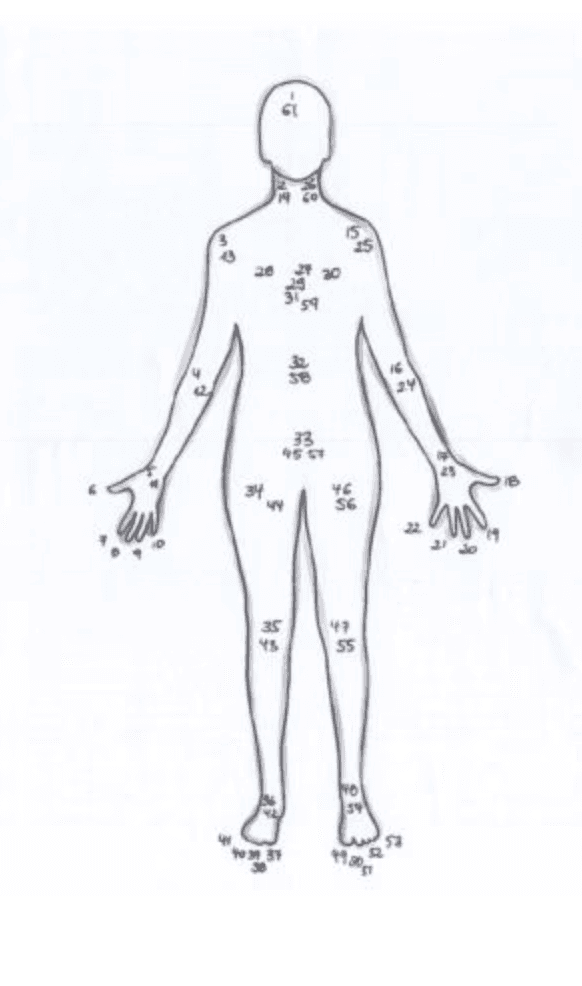
The 61 point meditation is a Yoga Nidra practice, a powerful meditation technique practiced lying in the Savasana pose. Yoga Nidra means “Yogic Sleep” because the practice takes us into a state midway between being asleep and awake. Our brainwaves are brought into the very low Delta wave frequency, as with non-REM sleep. Deep sleep is the key to overall health because it’s during this phase that the body naturally heals itself, as the mind.
Shifting attention to different body parts like in this exercise has a tantric origin (nyasa). Originally, it involves repeating Sanskrit mantras every time the person doing the practice moves to another part.
The 61-point meditation makes this practice accessible to everyone as there is no Sanskrit included. It can be accompanied by visualizations.
What benefits does this practice have?
Focusing on the 61 points draws our senses inwards (Pratyahara) – an important part of yogic practice – and away from what is causing us pain and making us anxious. We also focus our mind on a single point rather than trying to force it to be still, which is highly unnatural for it. Practicing focus has a high value in our modern live with social media and internet.
When we disconnect from the sensory channels and relax the 61 points, we feel a physical release because they’re all nerve rich and constantly send signals to our brain.
How do I do it?
It’s very simple. Focus on each point in turn, inhale and exhale and move on to the next one. If it’s hard for you to stay focused, only stay on one point for the inhale. Move on to the next one when you exhale.
Practicing the 61-point meditation has no effect if you only do it a little bit. Better to do the whole practice with no distractions. It might be hard for you to do this at first. If you have any tasks to do – finish them first, so you feel free for the meditation.
If you become very distracted, it means you’ve reached your limit. Honor your limits, finish, and try again tomorrow. Don’t create a habit of daydreaming.
Experiment and discover what time works best for you. It’s best not to be tired so avoid practicing the 61-point meditation at night or in bed.
Afternoon works best for me.
I offer you here a recording of the 61 point meditation with some modifications as I prefer to practice it in this way.
Or maybe you want to record your own voice!? It’s a great way to remember better the 61 points!
I would love to invite you to practice the 61-point meditation every day for the next 7 days.
The goal is for you to learn the 61-point meditation by heart, so you don’t need to listen to a recording (that draws your attention outwards again).
The original order is shown below.
The 61-point meditation is such an easy and powerful tool. When you master it, you’ll always have an amazing tool to use in moments of stress, anxiety, insomnia and anything else that disturbs the tranquility of your mind. That’s why we practice yoga: not to shine on our mat, but to learn tools to make our every day life free and fulfilled.
Let me know how the 7 days are going for you!
Thank you for your time,
Agnes XX

Agnes Kru
Calm the Mind. Reconnect the Body. Transform your Habits.
Professional Code Of Conduct (Read)
Professional Conduct and Integrity 1.1 I will conduct myself with professionalism, honesty, dignity and respect in all professional activities. 1.2 I will not engage in behaviour that brings my profession, ACCPH, or fellow practitioners into disrepute. 1.3 I will work within recognised ethical frameworks and within the scope of practice for which I am trained and competent. 1.4 I will declare conflicts of interest and avoid dual relationships that may impair professional judgement or objectivity. 2. Professional Competence and Development 2.1 I shall not claim qualifications, credentials, status or experience that I do not hold, nor use post-nominals I am not entitled to. 2.2 I will not offer services in any modality in which I am not adequately trained or qualified. 2.3 I will engage in ongoing professional development to maintain and enhance my knowledge and skills. 2.4 I recognise the limits of my competence and will refer clients to other professionals where appropriate. 3. Client Welfare and Safeguarding 3.1 I will act in the best interests of clients and prioritise their welfare, safety and autonomy. 3.2 I will not enter into a sexual, exploitative or abusive relationship with any client. 3.3 I will not take advantage of clients financially, emotionally or psychologically. 3.4 I will actively safeguard children and vulnerable adults and comply with relevant legal duties. 4. Medical, Therapeutic and Coaching Responsibility 4.1 I will not claim to diagnose, cure or treat medical conditions outside my professional remit. 4.2 I will not advise clients to discontinue prescribed medication or treatment from a medical professional. 4.3 I will respect the role and expertise of other healthcare and mental health professionals and collaborate responsibly where appropriate. 5. Confidentiality, Records and Data Protection 5.1 I will maintain client confidentiality in accordance with UK law, including data protection legislation (for oversees members, within the requirements of their residing country) 5.2 Confidential information may only be disclosed with consent, legal requirement, or where necessary to prevent serious harm. 5.3 I will maintain accurate and relevant records of my work. 5.4 I will store, retain and dispose of records securely and lawfully. 6. Fitness to Practise 6.1 I declare that I am fit to practise and do not have any condition that impairs my ability to work safely. 6.2 I will notify ACCPH if I develop a condition that affects my capacity to practise safely and will cease practice where necessary. 6.3 I will inform ACCPH of any unspent criminal convictions or legal restrictions that limit my ability to practise, especially with children or vulnerable adults. 7. Ethical Use of Techniques 7.1 I will not use hypnotherapy, hypnosis or related techniques for entertainment or any purpose that disrespects client dignity. 7.2 I will ensure that all interventions are used respectfully, professionally and for therapeutic or developmental purposes. 8. Advertising, Marketing and Public Representation 8.1 I will represent my services, qualifications and outcomes honestly and accurately in all advertising and promotional materials. 8.2 I will not make misleading, exaggerated or unsubstantiated claims. 8.3 I will not use testimonials, case studies or marketing materials that breach confidentiality or mislead the public. 9. Equality, Diversity and Inclusion 9.1 I will treat all clients fairly and without discrimination in accordance with the Equality Act 2010. 9.2 I will respect diversity of identity, experience and belief in all professional interactions. 10. Insurance and Legal Compliance 10.1 I will maintain appropriate professional indemnity and public liability insurance at all times. 10.2 I will comply with all relevant laws, regulations and safeguarding requirements applicable to my practice. 11. Professional Relationships and Endings 11.1 I will establish and maintain appropriate professional boundaries both in and outside of client sessions. 11.2 I will manage the ending of professional relationships responsibly and ensure appropriate signposting or referral where needed. 12. Conduct and Reputation 12.1 I will not associate with organisations that promote harmful, illegal or fraudulent practices. 12.2 I will uphold the reputation of ACCPH and the professions we represent. 13. Disciplinary Procedures 13.1 I accept the authority of ACCPH to investigate alleged breaches of this code. 13.2 I understand that ACCPH may impose sanctions, including suspension or termination of membership, where serious breaches occur. 14. Agreement to the Code I understand that failure to comply may result in disciplinary action, suspension or termination of membership.